


Expressive Arts Therapy Case Sharing: Work Stress
Expressive Arts Therapist: Liz Tong
Service User: SA
SA shared that she has recently been experiencing significant work-related stress. In our conversation, it emerged that her workload is heavy, and managing her subordinates requires considerable time and emotional energy.

Picking an Oh Card
I invited SA to choose OH cards to represent herself, her subordinates, and the overall atmosphere within the company. She did not have a particularly strong response to the cards symbolising herself or her team. However, when she turned over the card representing the company, she became visibly emotional and burst into tears.
She described the image on the card as conveying a sense of exclusion.
It transpired that she had fallen out with a colleague with whom she had previously been on friendly terms due to a particular incident. She felt that the way she had handled the situation might have upset her colleague. However, both of them chose to keep their thoughts to themselves rather than expressing their feelings openly.
Expressing the Ideal Relationship
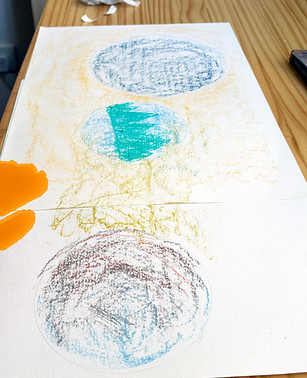
I invited SA to draw two circles on a sheet of paper—one to represent her colleague and one to represent herself. She illustrated her ideal scenario as the two circles positioned at a moderate distance from one another, neither too close nor too far apart. She shared that she would approach her colleague with a respectful attitude.
Expressing the Relationship in Discord
Then I invited her to draw another picture to represent the two of them at the time the incident occurred. The image immediately felt quite different; the lines within the circles became far more complex and layered.
Without realising it, she held the two drawings side by side and moved the two circles representing herself closer together, looking back and forth between them for quite some time. It felt as though she was becoming curious about her own inner world.
I asked SA whether her choice of colours held any particular meaning. She said it represented the ocean. I then invited her to express the two images through movement.

Understanding the Image through Movement & Exploring the Process of Transformation
Movement representing herself at the time of the incident:
Sitting on the chair, she swayed her upper body vigorously forwards, backwards, and from side to side.
Movement representing her ideal self:
Sitting on the chair, she swayed gently, with very small and subtle movements.
While embodying the movement of her ideal image, SA said, “I feel quite dizzy.”
I asked her, “If you’re feeling dizzy, what might help you feel steadier?”
She immediately picked up a green pen and drew a triangle in the middle of the “ocean”. Then, feeling it was not enough, she added two more triangles on either side, dividing the ocean into two parts. She explained that the green represented both mountains and trees—she called it “mountain trees”.
SA said, “Mountains are very solid. Trees sway—they’re flexible. Having both together feels better.”
I responded, “So there’s stability, but also some flexibility in how you respond to situations?”
SA replied, “Yes, not so rigid.”
I then invited SA to use movement to express the process of change between the two circles. She once again began swaying her body, and gradually her movement slowed until her body became completely still.
Afterwards, I invited her to use colour between the two circles to express the process. She drew messy brown lines in the space between them.
Frowning, SA said, “The colour feels very dirty… it feels unpleasant.”
I responded, “Mm, it feels dirty and uncomfortable—perhaps even repulsive—and yet it may also be a necessary stage within the process of change…”

Finding Direction through Movement
I invited her to repeat the sequence of movements once more.
I asked, “Notice what you’re following as you move—what allows the intense swaying at the beginning to settle into stillness at the end?”
SA carefully repeated the movements. Afterwards, she added a beam of light in the middle of the messy brown lines.
SA said, “This beam of light represents Buddhist practice. The teachings do not harm others, and from my own experience I know they are right. I can trust these practices to help me become better.”
I responded, “You have a great deal of trust in Buddhist practice, and it seems to offer you direction. As you look at the whole picture now, how do you feel?”
SA replied, “I feel that I can manage it.”
I then invited SA to sense this confidence within her body. She shared that she felt much more relaxed and grounded.
I asked, “Now, as you look again at the circle representing that colleague, having placed more ‘mountain trees’ between you, how do you think your colleague will respond?”
SA said, “How she responds is beyond my control—but that’s no longer so important.”
I reflected, “As long as you conduct yourself well, her reaction no longer affects you as much?”
SA nodded, “Yes.”
When work becomes overwhelming and emotions accumulate without being processed, they can turn into psychological stress. Expressing emotions through art, and using imagination to view events from a fresh perspective, can bring greater clarity and a more dimensional understanding of your experience.
***Client has given consent to share photos of artwork and the therapy process.
